AI brand monitoring: track your brand in AI answers
When buyers ask an assistant what to use, your brand is either in the answer or it isn’t — and that can change with any model update. AI brand monitoring keeps watch so a silent drop doesn’t cost you customers before you notice.
What AI brand monitoring is
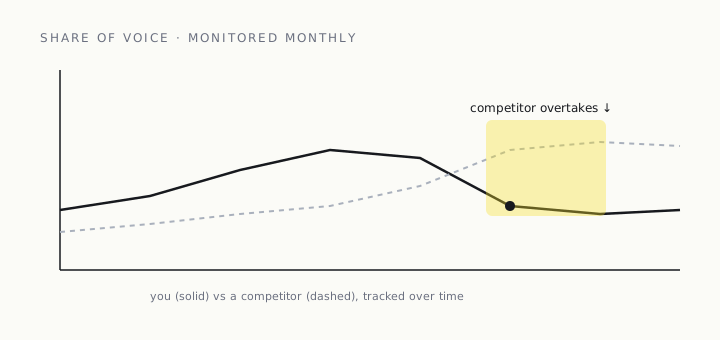
AI brand monitoring is the ongoing practice of tracking whether AI assistants name and recommend your brand when people ask questions in your category. Where classic rank tracking watches your position in a list of links, AI brand monitoring watches something harder to see: the sentence an assistant says out loud. It follows four signals over time — how often you are mentioned, where you rank when you are, your share of voice against competitors, and which third-party sources the models cite to justify the answer.
Why it matters now
AI answers are not stable. A model update, a new competitor’s content push, or a shift in which sources an assistant trusts can quietly remove you from the recommendation — with no ranking-drop notification to warn you. By the time the referral traffic dips, the change happened weeks ago. Monitoring exists to close that gap: catch the drop when it happens, see who took your spot, and know which prompts you are losing while you can still act. The discipline sits under the wider practice of generative engine optimization.
What to monitor
Four numbers carry most of the signal. Mention rate — across the buyer questions you track, how often you are named at all. Average rank — first pick or closing aside. Share of voice — your mentions as a percentage of every brand the models raise. Citations and sentiment — which sources the answer leans on, and whether you are described in flattering or lukewarm terms. Good AI brand monitoring tracks all four per engine, because the assistant your buyers use matters as much as the score.
AI brand monitoring tools compared
The market splits into a free baseline layer and paid monitoring platforms. Start cheap, prove the gap, then pay for the trend line.
| Tool | Best for |
|---|---|
| VisibilityChecker.ai | The baseline before you monitor |
| Profound | Enterprise monitoring programs |
| Otterly.AI | Weekly prompt monitoring |
| Peec AI | Competitive share-of-voice monitoring |
| Ahrefs Brand Radar | Monitoring inside an SEO suite |
| Semrush | Monitoring across the whole funnel |
1. VisibilityChecker.ai
Monitoring only pays off once you know a gap exists. Type your brand and get a live reading in about a minute — mention rate, average rank and share of voice across GPT, Grok and Claude, every answer shown. Free during launch, no sign-up. Re-run it after each change to see the trend without a subscription.
2. Profound
Continuous, well-funded answer-engine monitoring: tracks how assistants describe your brand over time, analyses which sources they cite, and feeds content recommendations to large teams running AI brand monitoring as an ongoing program. Enterprise pricing.
3. Otterly.AI
Watches your chosen prompts across ChatGPT, Perplexity and Google AI Overviews on a schedule, reporting brand mentions, link citations and sentiment each cycle. A focused, marketer-friendly way to monitor a defined prompt set. Freemium.
4. Peec AI
Built around benchmarking: monitor your visibility score, cited sources and rankings across AI engines and chart them against competitors over time — useful when the point of monitoring is to show clients where they stand. Paid.
5. Ahrefs Brand Radar
Tracks brand mentions and citations in AI answers next to your classic rankings, keywords and backlinks. The natural monitoring layer if your team already works in Ahrefs and wants AI data in the same place. Paid suite.
6. Semrush
Layers AI-answer tracking onto a full marketing platform, so brand monitoring sits beside paid, social and organic reporting in one dashboard — a fit for agencies standardising on a single tool. Paid suite.
How to start monitoring without overspending
The cheapest honest sequence: take a free baseline check to confirm a gap exists at all, fix the obvious problems it exposes — entity clarity, citable sources, the prompts you clearly lose — then re-check and see if the numbers moved. Only once you have proven there is a gap worth watching does a paid monitoring subscription earn its price. Buying the platform first is how teams end up paying monthly to watch a number that was fine all along.
Get your baseline before you buy monitoring
One free check: mention rate, average rank and share of voice across GPT, Grok and Claude, every answer attached. Free during launch, no sign-up.
AI brand monitoring FAQ
What is AI brand monitoring?
AI brand monitoring is the ongoing tracking of whether — and how — AI assistants like ChatGPT, Gemini, Perplexity and Grok mention your brand when people ask for options in your category. It watches mention rate, share of voice, sentiment and which sources the models cite, and alerts you when they change. Think rank tracking, but for AI answers instead of search results.
How is AI brand monitoring different from a one-off check?
A check is a snapshot: do the models name you today, where, and against whom. Monitoring re-asks on a schedule and charts the trend, so you catch a drop before the traffic does. The cost-efficient sequence is to take a free baseline check first, do the optimization work, then decide whether a paid monitoring subscription is worth it for your category.
Which AI engines should brand monitoring cover?
At minimum the assistants your buyers actually use — commonly ChatGPT, Google's Gemini and AI Overviews, Perplexity and Grok. Coverage varies by tool, so match the monitored engines to where your audience asks their questions rather than paying for engines that never send you buyers.
How often should AI brand monitoring run?
AI answers shift with every model update, so anything from weekly to monthly is reasonable. Competitive categories monitor weekly; slower-moving ones monthly. The trigger for paying for continuous monitoring is simple: once a proven visibility gap is costing you revenue, the trend line earns its keep.
Related: the 10 best AI visibility tools · GEO tools in 2026 · ChatGPT visibility checker.