How to rank in AI Overviews
Google now answers many searches with an AI Overview above the links — one synthesised paragraph that cites a few sources. Ranking there means being one of those cited sources, which is an optimization problem, not a bidding one.
What AI Overviews changed
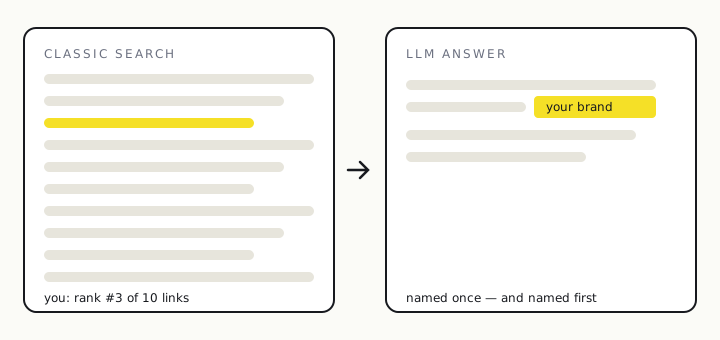
For a growing share of queries, the first thing a searcher reads is not your title tag in a list of ten — it is a Google-written summary that names and links a handful of sources. If you are one of them, you get the citation and the click-through that follows; if you are not, a page that ranks #3 in the classic results can still be invisible above the fold. That is the shift AI Overviews force: from winning a position to being part of the answer.
The levers that get you cited
Four things move the needle, and none of them is a purchase. Entity clarity — a consistent, unambiguous description of what you are, so the model can place you. Question-fit content — pages that answer the specific question directly, not generically. Parseable structure — clean headings, lists and facts a model can extract without guessing. Corroboration — coverage on the third-party sources Google already trusts, since an overview leans on the wider web, not just your own claims. Classic ranking helps, but the overview routinely cites pages that are not first.
Google itself documents how its AI features surface web content — the mechanics are not a secret, they are an editorial-quality problem.
Measure before you optimise
Here is the honest part: this site’s checker does not query Google AI Overviews. It queries the assistant surface — GPT, Grok and Claude. But the work is shared. The entity clarity and citable-source signals that get you named by the assistants are the same signals that get you cited in AI Overviews, so an assistant-surface baseline is the cheapest, fastest read on whether your GEO foundations are working. Fix what it exposes, and both surfaces move together.
Do AI Overviews reduce your traffic?
They change it more than they simply reduce it. For informational queries an overview can answer the question outright, so raw impressions fall — but the citations that remain carry unusually qualified clicks, because the reader has already been told you are a source worth checking. The losing move is to ignore the surface and watch a competitor become the cited authority in your category. The winning move is to be the source the summary quotes, then measure whether the underlying signals are working rather than guessing from a traffic chart that now mixes two very different behaviours.
Get a GEO baseline in a minute — free during launch
See whether GPT, Grok and Claude name you today: mention rate, average rank and share of voice, every answer attached. The same signals feed AI Overviews.
AI Overviews FAQ
What are Google AI Overviews?
AI Overviews are the AI-generated summaries Google places above the classic blue links for many queries. Instead of ten results, the user reads one synthesised answer that draws on — and links to — a handful of sources. Ranking in them means being one of the sources that answer cites and paraphrases, which is a different game from holding a blue-link position.
How do I rank in AI Overviews?
You earn citations rather than buy positions. The levers are entity clarity (an unambiguous, consistent description of what you are), genuinely useful content that answers the specific question, structure a model can parse, and being corroborated by the third-party sources Google already trusts. Strong classic rankings help but do not guarantee inclusion — the overview often cites pages that are not #1.
Does VisibilityChecker measure AI Overviews?
No, and it says so plainly. This checker queries GPT, Grok and Claude — the assistant surface — not Google AI Overviews. It is an honest adjacent signal: the entity clarity and citable-source work that gets you named by the assistants is the same work that gets you cited in AI Overviews, so an assistant-surface baseline is the cheapest place to start. The report only claims what it actually tested.
Is ranking in AI Overviews the same as GEO?
AI Overviews optimization is one surface of generative engine optimization (GEO). GEO is the broader discipline of getting named and cited across AI answers — Google's overviews, ChatGPT, Perplexity and the rest. The levers are largely shared, which is why teams treat measurement on any one surface as a proxy while they fix the underlying signals.
Related: GEO tools in 2026 · Perplexity SEO · the 10 best AI visibility tools.